missknn
Fast Masked K-Nearest Neighbor Imputation
Fast masked k-nearest neighbor imputation for mixed-type tabular data. Distances are computed only on the variables jointly observed by the receiver and the donor, and missing values are filled by local regression (numeric) or weighted vote (categorical) over the nearest donors. Returns completed data for single imputation or a list of completed data sets for multiple imputation.
missknn
missknn is an R package for fast masked k-nearest neighbor imputation
of missing values in tabular data.
Installation
Install the released version from CRAN with:
install.packages("missknn")
Or install the development version from GitHub with:
install.packages("remotes")
remotes::install_github("ielbadisy/missknn")
What’s new in 1.2.0
missknn()is now an imputer only and returns completed data directly: adata.framewhenm = 1, a list ofmcompleted data frames (classc("mimar_mi", "list")) whenm >= 2.complete(), themissknnobject class and itsprint()/summary()methods are removed; pool analyses with a dedicated package such asmimar(mimar::pool_lm()).data.tableis no longer a dependency: tabular handling usesbasetable(>= 1.4.2) and outputs are plain data frames. OnlyNAcells are imputed (blank strings stay a valid category) and ordered factors are restored as ordered factors.- The
"tuning"attribute now reports the number ofmissingvalues per variable.
It is fast by design:
- distance computation, donor ranking, and aggregation are done in C++,
with partial (not full) top-
kselection and a batched per-column API that avoids per-cell R/C++ round trips - each column’s
kand estimator (distance-weighted mean vs. a local weighted-regression fit) are chosen automatically from a holdout evaluation, rather than fixed globally - columns with no locally exploitable signal are detected and filled directly from the global mean/mode, skipping neighbor search entirely
- a
donor_capbounds the neighbor-search candidate pool so cost stays roughly linear inninstead of quadratic, which matters at largen basetablebackend for tabular handling; input is a data frame or matrix, output is plain data frames- multiple imputation (
m > 1) can run multicore by default on Unix-like systems viaparallel::mclapply - within a single imputation, the per-column holdout
k/estimator tuning and the deterministic (non-stochastic) neighbor search are parallelized across columns/receivers withRcppParallel, on all platforms including Windows
It supports:
- single imputation
- multiple imputation
- numeric and mixed tabular data
- an imputer-only interface: completed data in, analysis and pooling
left to tools such as
mimar
About
missknn is developed and maintained by Imad El Badisy
(elbadisyimad@gmail.com), released under the MIT license.
Latest Implementation
The current implementation parallelizes the per-column k/estimator
tuning and the deterministic single-imputation path with RcppParallel,
including on Windows. The m > 1 stochastic path still uses
process-level parallelism via parallel::mclapply on Unix-like systems.
Parallel computing
missknn parallelizes at two independent levels:
- Across imputations (
m > 1): each of themcompleted datasets is generated in a separate process viaparallel::mclapply, controlled byparallel_cores(defaults todetectCores() - 1). This only applies on Unix-like systems; it falls back to serial on Windows. - Within a single imputation: the per-column holdout search that
picks each column’s
kand estimator, and the deterministic (m = 1) neighbor search/aggregation, are split across threads withRcppParallel::parallelFor(across target columns for tuning, across receiver rows for imputation). This runs on every platform, including Windows, and benefitsm = 1runs that get no benefit fromparallel_cores. The stochastic sampling path used whenm > 1stays single-threaded per process, since R’s RNG isn’t thread-safe; that case still parallelizes across themprocesses instead.
Thread count for the RcppParallel layer follows the usual
RcppParallel::setThreadOptions() / RCPP_PARALLEL_NUM_THREADS
conventions.
Progress reporting
imp <- missknn(big_data, k = 5, progress = TRUE)
With progress = TRUE, missknn() shows a live, self-contained (base R
only, no extra dependency) progress bar for each tuning stage
(Tuning numeric columns, Tuning categorical columns) and for each
column that goes through the neighbor search (Imputing <column>),
updating in place with a percentage and an ETA, e.g.:
Imputing x2 [===========>------------------] 38% ETA: 4s
Columns with no locally exploitable signal (filled directly from the
global mean/mode, see the missknn() API entry below) don’t get a bar,
since they skip the neighbor search entirely.
Because RcppParallel worker threads can’t safely drive a progress
display, requesting progress = TRUE runs that column’s search on a
single thread instead of in parallel: an explicit, visible-vs-fast
tradeoff, not a bug. Leave progress = FALSE (the default) for the
fastest run. progress is also automatically disabled whenever m > 1
with parallel_cores > 1, since console output from
parallel::mclapply’s forked worker processes can’t be shown live.
Benchmark
Two benchmark scripts write reports, plots, and CSV tables to
inst/benchmark/output/:
# accuracy/runtime vs. missForest, missMDA, VIM::kNN at n = 200, 30 simulations
Rscript inst/benchmark/benchmark_30.R

# runtime/accuracy vs. missMDA and missForest as n scales from 1,000 to 100,000
Rscript inst/benchmark/benchmark_bigdata.R
API
missknn(data, k = 5L, m = 1L, scale = TRUE, add_indicator = FALSE, seed = NULL, weights = c("distance", "uniform"), numeric_estimator = c("regression", "mean"), ridge = 1e-4, donor_cap = 2000L, max_iter = 1L, parallel_cores = missknn_default_cores(), progress = FALSE)
Fits masked KNN imputation and returns the completed data.
| Argument | Description |
|---|---|
data |
A data.frame or matrix. |
k |
Number of nearest donors used per target column. |
m |
Number of completed datasets. m = 1 is single (deterministic) imputation; m > 1 is multiple (stochastic donor-sampling) imputation. |
scale |
Standardize numeric variables before computing distances. |
add_indicator |
Append 0/1 integer missingness-indicator columns (<name>_missing) to the completed output. |
seed |
Integer seed for reproducible multiple imputation. |
weights |
"distance" (inverse-distance weighted aggregation) or "uniform" (equal weights) over the k donors. |
numeric_estimator |
"regression" fits a distance-weighted local linear regression of the target on the receiver’s observed numeric predictors over the k donors, falling back to the weighted mean when the local design is degenerate; "mean" always uses the weighted mean. |
ridge |
Ridge penalty added to the predictor covariance under numeric_estimator = "regression". |
donor_cap |
Caps the donor pool searched per target column, subsampling once per column when exceeded, so search cost stays roughly linear in n. Does not affect the global mean/mode fallback, which always uses every donor. |
max_iter |
Number of single-pass refinement iterations over the whole dataset. |
parallel_cores |
Cores used across the m completed datasets when m > 1 (via parallel::mclapply, Unix-like only). Defaults to detectCores() - 1. Independent of the RcppParallel threading used within a single imputation (see Parallel computing). |
progress |
Show a live console progress bar per tuning stage and per imputed column (see Progress reporting). Default FALSE. |
Columns with no locally exploitable signal are detected during fitting and filled from the global mean/mode directly, without a neighbor search.
Returns completed data directly:
m = 1: adata.framewith the same columns and column types as the input.m >= 2: a list ofmcompleted data frames with classc("mimar_mi", "list").
missknn is an imputer only. Fit the analysis model on each completed
data set and pool the fits with Rubin’s rules using a dedicated package
such as mimar (mimar::pool_lm()).
Example
library(missknn)

x <- data.frame(
  a = c(1.2, 2.1, NA, 4.3, 5.0, 6.4, NA, 8.1),
  b = c(2.5, NA, 3.1, 5.2, 4.8, NA, 7.9, 8.3),
  g = factor(c("x", "x", "y", NA, "y", "x", "y", NA))
)

missknn(x, k = 2)
#>          a        b g
#> 1 1.200000 2.500000 x
#> 2 2.100000 2.641362 x
#> 3 3.450772 3.100000 y
#> 4 4.300000 5.200000 y
#> 5 5.000000 4.800000 y
#> 6 6.400000 8.117406 x
#> 7 7.621611 7.900000 y
#> 8 8.100000 8.300000 y
Each result carries a "tuning" attribute giving, per variable, the
number of missing values, the tuned k, the estimator used and
whether it was filled from the global mean/mode:
attr(missknn(x, k = 2), "tuning")
#>   variable missing k  estimator global
#> a        a       2 2 regression  FALSE
#> b        b       2 2 regression  FALSE
#> g        g       2 2       vote  FALSE
Multiple imputation returns a list of completed data frames, ready for
analysis and pooling with mimar:
# multiple imputation: a list of 5 completed data frames
imps <- missknn(x, k = 2, m = 5, seed = 1, parallel_cores = 1L)
class(imps)
#> [1] "mimar_mi" "list"
imps[[2]]
#>     a   b g
#> 1 1.2 2.5 x
#> 2 2.1 2.5 x
#> 3 1.2 3.1 y
#> 4 4.3 5.2 y
#> 5 5.0 4.8 y
#> 6 6.4 8.3 x
#> 7 8.1 7.9 y
#> 8 8.1 8.3 y
fits <- lapply(imps, function(d) lm(a ~ b, data = d))
mimar::pool_lm(fits)
#> Pooled linear model
#> Pooled across m = 5 imputations (Rubin's rules)
#>
#>             Estimate Std. Error    df t value Pr(>|t|)
#> (Intercept)  -0.2727     1.6125 2.123  -0.169   0.8805
#> b             0.9660     0.2412 3.110   4.004   0.0261 *
#> ---
#> Signif. codes:  0 '***' 0.001 '**' 0.01 '*' 0.05 '.' 0.1 ' ' 1
Execution time vs. sample size
Runtime and NRMSE from n = 1,000 up to n = 100,000 (5 numeric columns,
20% MCAR per column). missForest and VIM::kNN are only run up to n =
5,000 (per-tree cost and O(n^2) distance search respectively make larger
n impractical); missknn and missRanger run across the full grid.
Reproduce with:
Rscript inst/benchmark/benchmark_bigdata.R
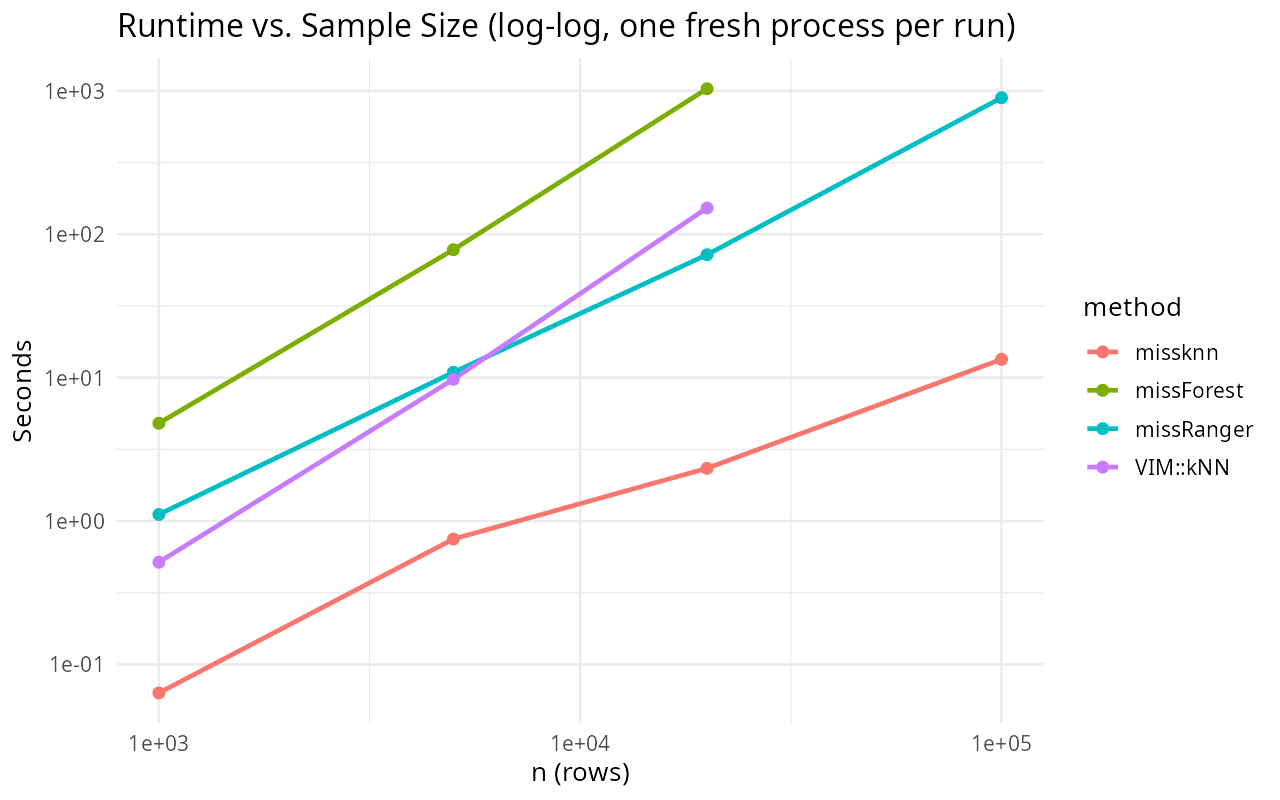 Runtime plot
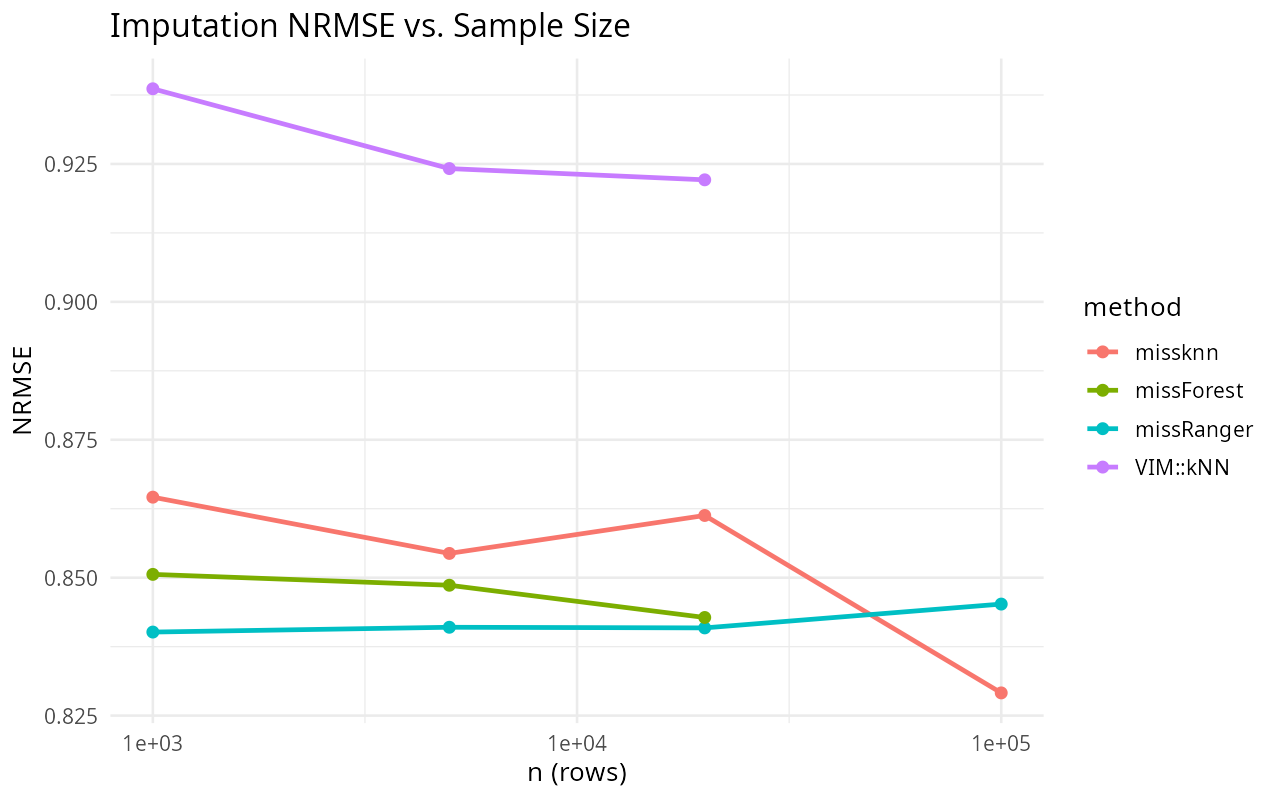 NRMSE plot
| n | method | runtime_sec | nrmse |
|---|---|---|---|
| 1,000 | missknn | 0.0131 | 1.00223 |
| 1,000 | missRanger | 0.1630 | 1.15781 |
| 1,000 | missForest | 3.1537 | 1.07461 |
| 1,000 | VIM::kNN | 0.6088 | 1.16132 |
| 5,000 | missknn | 0.0321 | 1.00020 |
| 5,000 | missRanger | 1.3632 | 1.14478 |
| 5,000 | missForest | 75.1881 | 1.03685 |
| 5,000 | VIM::kNN | 10.9076 | 1.15992 |
| 20,000 | missknn | 0.0456 | 0.99998 |
| 20,000 | missRanger | 10.3372 | 1.14941 |
| 100,000 | missknn | 0.0938 | 1.00000 |
| 100,000 | missRanger | 85.6539 | 1.14435 |
Runtime and NRMSE by method and sample size
missForest’s runtime already becomes impractical at n = 5,000 (over a
minute) and would take hours at n = 100,000; VIM::kNN’s distance
search is similarly infeasible past a few thousand rows. missknn’s
capped-donor masked-KNN search stays close to linear in n and keeps
running in well under a second even at n = 100,000. missRanger also
scales to n = 100,000 but at substantially higher runtime.
Citation
citation("missknn")
#> To cite missknn in publications, use:
#>
#>   El Badisy I (2026). _missknn: Fast Masked K-Nearest Neighbor
#>   Imputation_. R package version 1.2.0,
#>   <https://CRAN.R-project.org/package=missknn>.
#>
#> A BibTeX entry for LaTeX users is
#>
#>   @Manual{,
#>     title = {missknn: Fast Masked K-Nearest Neighbor Imputation},
#>     author = {Imad {El Badisy}},
#>     year = {2026},
#>     note = {R package version 1.2.0},
#>     url = {https://CRAN.R-project.org/package=missknn},
#>   }