sbm
Stochastic Blockmodels
A collection of tools and functions to adjust a variety of stochastic blockmodels (SBM).
Supports at the moment Simple, Bipartite, 'Multipartite' and Multiplex SBM (undirected or directed with Bernoulli, Poisson or Gaussian emission laws on the edges). For Simple and Bipartite SBM, covariates can be given on the edges, or on the nodes to drive the block memberships, and the network may contain missing values. See Léger (2016)
sbm: Stochastic Blockmodels


sbm gathers in a single framework the tools to simulate, estimate and represent a variety of stochastic block models (SBM), a family of models that cluster the nodes of a network into blocks sharing the same connectivity patterns.
Supported models
| Network | Function | Estimation engine |
|---|---|---|
| Simple (one set of nodes, directed or not) | estimateSimpleSBM() |
blockmodels |
| Bipartite (two sets of nodes) | estimateBipartiteSBM() |
blockmodels |
| Multipartite (several sets of nodes and networks) | estimateMultipartiteSBM() |
GREMLINS |
| Multiplex (several networks on the same nodes) | estimateMultiplexSBM() |
GREMLINS (independent layers), blockmodels (dependent layers) |
- Emission distributions on the edges: Bernoulli (binary networks), Poisson (counts) and Gaussian (weights).
- Covariates, for simple and bipartite SBM: on the edges, acting on the connectivity, or on the nodes, driving the block memberships.
- Missing values (
NA) in the networks: the missing dyads are ignored in the inference (see the help pages for the details of each model). - Model selection of the number of blocks with the Integrated Classification Likelihood (ICL).
- Graphics with ggplot2: reordered matrices, expected networks, graphons, mesoscopic views and alluvial plots.
- Simulation of networks with
sampleSimpleSBM(),sampleBipartiteSBM(),sampleMultipartiteSBM()andsampleMultiplexSBM().
Installation
The stable version is available on CRAN:
install.packages("sbm")
The development version can be installed from GitHub:
# install.packages("pak")
pak::pak("GrossSBM/sbm")
Example
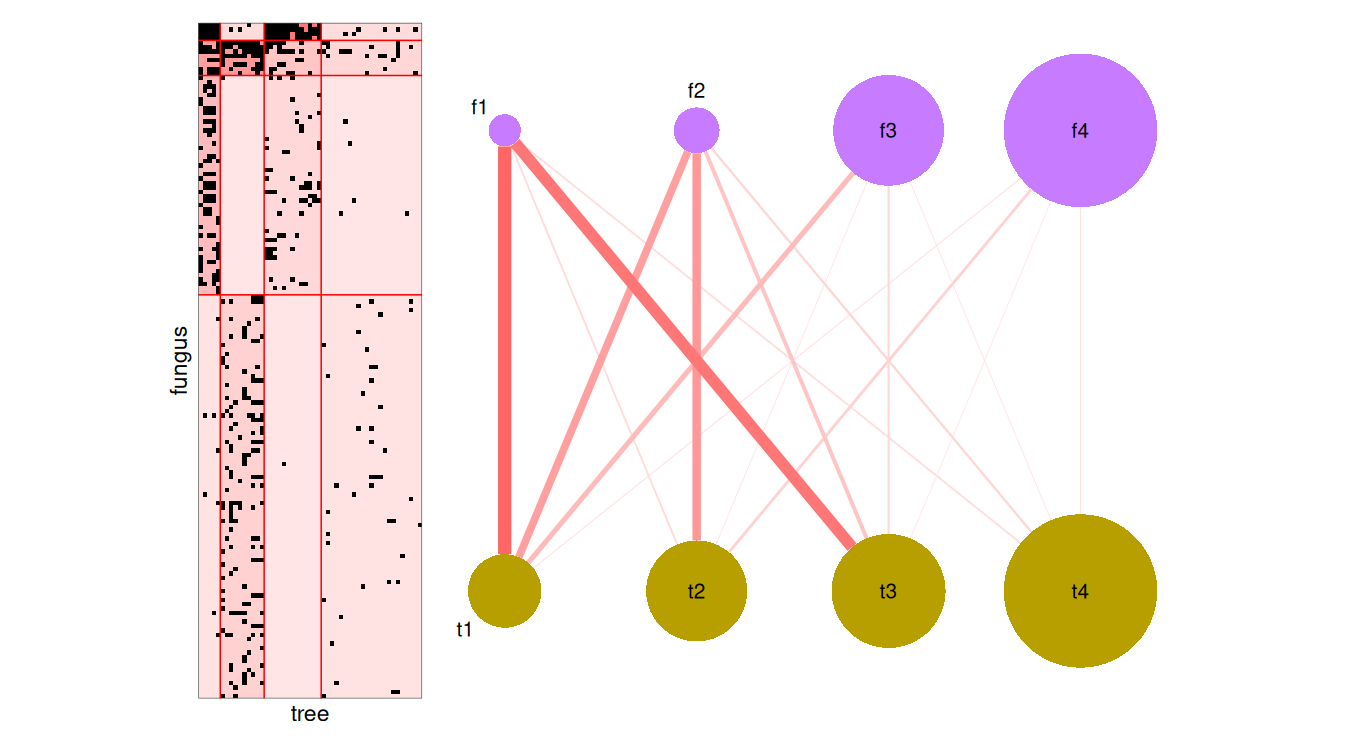
The data set fungusTreeNetwork records the interactions between 154
fungal species and 51 tree species. A bipartite SBM groups the fungi and
the trees into blocks sharing the same interaction patterns, the number
of blocks being chosen with the ICL.
library(sbm)
data("fungusTreeNetwork")
fungusTree <- fungusTreeNetwork$fungus_tree

fit <- estimateBipartiteSBM(
  fungusTree, model = "bernoulli", dimLabels = c(row = "fungus", col = "tree"),
  estimOptions = list(verbosity = 0, plot = FALSE, nbCores = 1)
)
fit$nbBlocks
#> fungus   tree
#>      4      4
library(patchwork)
plot(fit, type = "data") + plot(fit, type = "meso")
The vignettes go further: model principles, case studies on simple, bipartite, multipartite and multiplex networks, and covariates on the nodes.
Related packages
- blockmodels: estimation of simple and bipartite SBM (and of dependent multiplex SBM), used by sbm.
- GREMLINS: estimation of multipartite SBM, used by sbm.
- missSBM: SBM for networks with missing data, under various sampling designs (missing at random or not).
- shinySbm: a Shiny application to fit SBM with sbm.
References
- Léger, J.-B. (2016). Blockmodels: A R-package for estimating in Latent Block Model and Stochastic Block Model, with various probability functions, with or without covariates. arXiv:1602.07587.
- Barbillon, P., Donnet, S., Lazega, E. and Bar-Hen, A. (2017). Stochastic block models for multiplex networks: an application to a multilevel network of researchers. Journal of the Royal Statistical Society: Series A, 180(1), 295–314. doi:10.1111/rssa.12193.
- Bar-Hen, A., Barbillon, P. and Donnet, S. (2022). Block models for generalized multipartite networks: Applications in ecology and ethnobiology. Statistical Modelling, 22(4), 273–296. doi:10.1177/1471082X20963254.