vrpr
Vehicle Routing Problem Solver Built on 'PyVRP'
A 'tidyverse'-style interface to high-performance vehicle routing problem (VRP) solving. Vendors the C++ core of the 'PyVRP' solver (< https://github.com/PyVRP/PyVRP>) and rewires it through 'cpp11', with no 'Python' runtime dependency. Supports the capacitated VRP, time windows, multiple depots, heterogeneous fleets, prize-collecting and multi-trip variants, driven by an iterated local search metaheuristic.
vrpr 


A production-grade vehicle routing problem (VRP) solver for R.
vrpr brings the state-of-the-art PyVRP solver to R. It vendors PyVRP's high-performance C++ core and rewires it with cpp11, wrapped in an idiomatic, tidyverse-style API: a pipe-friendly model builder, data in tibbles, and logging via cli — with no Python runtime dependency.
It fills a real gap in the R ecosystem: there are ompr, ROI, lpSolve, igraph and dodgr,
but no modern, strong, friendly solver for production vehicle routing.
Highlights
- All the classic VRP variants, from one tidy interface: capacitated VRP, time windows (VRPTW), heterogeneous fleets, multiple depots (MDVRP), prize-collecting with optional clients and mutually exclusive groups, simultaneous pickup & delivery / backhaul, paired pickup-and-delivery shipments (PDP/PDPTW), and multi-trip routes.
- Fast — the search runs entirely in PyVRP's C++ core (iterated local search with late-acceptance hill-climbing). No Python required.
- Verified parity with PyVRP — identical objective, and on the X-n101-k25 benchmark (optimum
27591) both reach the optimum in 20 s (see
tools/benchmark/). - Reads standard instances (VRPLIB / TSPLIB and Solomon) and plots solutions with ggplot2.
Installation
Install the released version from CRAN:
install.packages("vrpr")
Or the development version from GitHub:
# install.packages("pak")
pak::pak("StrategicProjects/vrpr")
A C++20 toolchain is required to build from source (R >= 4.3).
Quick start
library(vrpr)

clients <- tibble::tibble(
  x = c(10, 25, 40, 15), y = c(5, 30, 12, 22),
  demand = c(10, 15, 8, 12)
)

res <- vrp_model() |>
  add_depot(x = 0, y = 0) |>
  add_clients(clients) |>
  add_vehicle_type(num_available = 3, capacity = 50) |>
  vrp_solve(stop = max_runtime(2))

cost(res)      # objective cost
routes(res)    # tibble: route_id, depot, position, client, vehicle_type, ...
summary(res)   # one-row summary
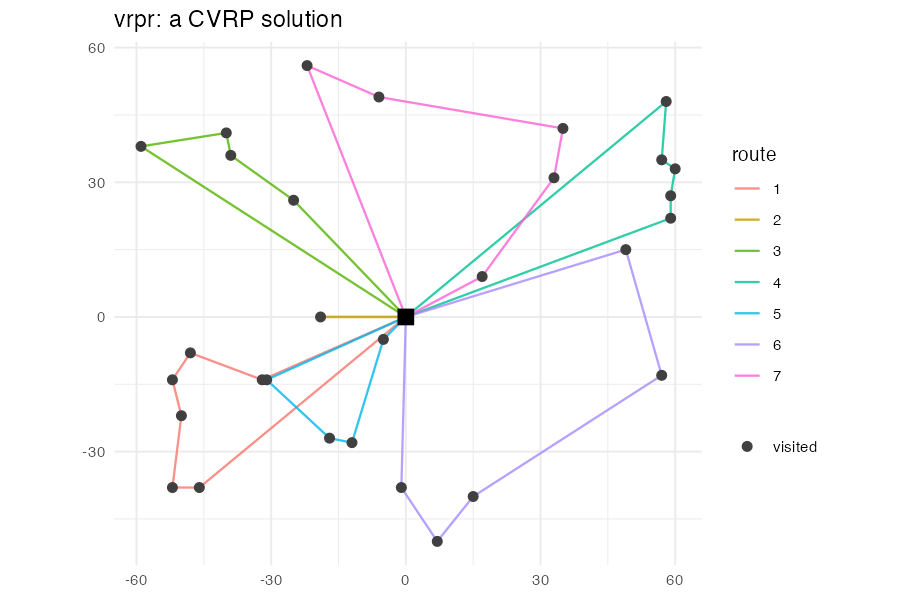
plot(res)      # the routes, with {ggplot2}
Variants
| Variant | How |
|---|---|
| Time windows (VRPTW) | add tw_early, tw_late, service to clients |
| Heterogeneous fleet | call add_vehicle_type() several times with different capacities/costs |
| Multiple depots (MDVRP) | several add_depot() + add_vehicle_type(depot = i) |
| Prize-collecting | required = FALSE + prize on clients; add_client_group() for exclusive sets |
| Pickup & delivery / backhaul | add a pickup column to clients |
| Paired pickup-and-delivery (PDP) | add_shipments() with pickup/delivery points |
| Multi-trip | add_vehicle_type(reload_depots = i, max_reloads = k) |
See the Getting started guide and the Articles for worked examples of each.
Distances and durations
By default vrpr uses the rounded Euclidean distance between coordinates, and travel time equals
distance. For real road networks, pass your own matrices (e.g. from OSRM, osrm, osmnx, or any
routing engine) to vrp_solve() or vrp_problem_data():
# dist: n x n metres, time: n x n seconds, for depots, then clients
# (then shipment pickup/delivery pairs), in the order they were added.
res <- vrp_model() |>
  add_depot(x = 0, y = 0) |>
  add_clients(clients) |>
  add_vehicle_type(num_available = 3, capacity = 50) |>
  vrp_solve(stop = max_runtime(2), distance = dist, duration = time)
Matrices may be asymmetric and must be integer-valued (round to metres/seconds first). With explicit
matrices, the coordinates are only used by plot().
Reading standard instances
m <- read_vrplib(system.file("extdata", "sample-n6-k2.vrp", package = "vrpr"))
m <- read_solomon(system.file("extdata", "sample-solomon.txt", package = "vrpr"))
res <- m |> vrp_solve(stop = max_runtime(5))
How it works

vrpr is a thin, idiomatic R skin over PyVRP's C++ engine:
- Tidy R API — you build a model from tibbles and call
vrp_solve(). - R orchestration — the iterated local search loop, penalty manager and stopping criteria, a
faithful port of PyVRP's
IteratedLocalSearch. - cpp11 binding — long-lived C++ objects travel as external pointers; data crosses as tibbles and matrices, with integer-measure validation at the boundary.
- Vendored PyVRP C++ core (
src/vendor/pyvrp/, version pinned intools/PYVRP_VERSION) — the hot compute: problem data, cost evaluation, solutions and the local-search operators.
The light R loop drives the heavy C++ search, so you get PyVRP-grade performance with a pure-R, Python-free workflow.
License
MIT. Derived from PyVRP (© PyVRP contributors, Thibaut Vidal, ORTEC), whose copyright is preserved;
see inst/COPYRIGHTS.